
Pool heating systems
A pool heating system allows you to extend the swimming season by several weeks in spring and autumn.
During the summer months, it can even heat the water to temperatures of up to 32°C. Depending on the heating capacity, it is also possible to heat the pool throughout the winter, although energy consumption and operating costs should be taken into consideration. We would be happy to advise you in finding the ideal solution for your pool project. There are several options available for heating your swimming pool.
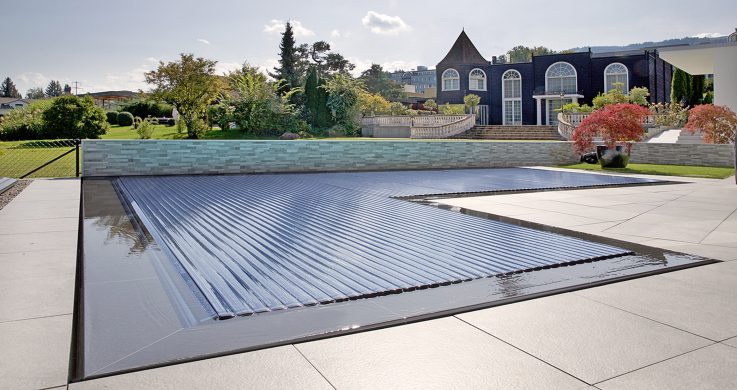
Solar slats
The solar slats are seamlessly integrated into the automatic roller shutter cover. Thanks to their special design and material properties, solar heat is transferred directly into the water. This innovative heating solution is extremely popular and the best-selling system of its kind. By harnessing free solar energy, the swimming season can be extended by several weeks. Many satisfied customers throughout Switzerland rely on this efficient system.
Air-to-water heat pump
The air-to-water heat pump works similarly to a refrigerator in reverse. It draws in outside air through a fan, where it meets a refrigerant that evaporates as a result. A compressor then compresses the vaporized refrigerant, releasing the stored energy. The heat pump is directly integrated into the filtration circuit. The released energy is transferred to the pool water, heating it efficiently. The greater the temperature difference between the ambient air and the desired pool temperature, the more electricity is required to generate the heat.
Investing in a heat pump is worthwhile if you want to become independent of fossil fuels and switch to a future-proof technology. Since no combustion process takes place and the system itself emits no CO₂ during operation, it is also a leading solution in terms of sustainability. Another significant advantage is the minimal structural work required for installation.


Heat exchanger
The tubular heat exchanger or plate heat exchanger is connected to the central heating system and operates with two hydraulic circuits. The primary circuit carries the hot water supplied by the central heating system, while the secondary circuit contains the pool water to be heated. The two circuits do not come into direct contact; instead, they flow past each other to transfer heat efficiently. The larger the heat exchange surface, the more effective the heating performance.
A heat exchanger may only be used in combination with renewable heating energy sources. In addition, the required heating capacity must be coordinated with your heating installer.
Do you have any questions about swimming pool heaters?
We look forward to hearing from you and will be happy to advise you on your request.

Management